Merlino Marketing · April 2026
Is doing a local SEO worth it?
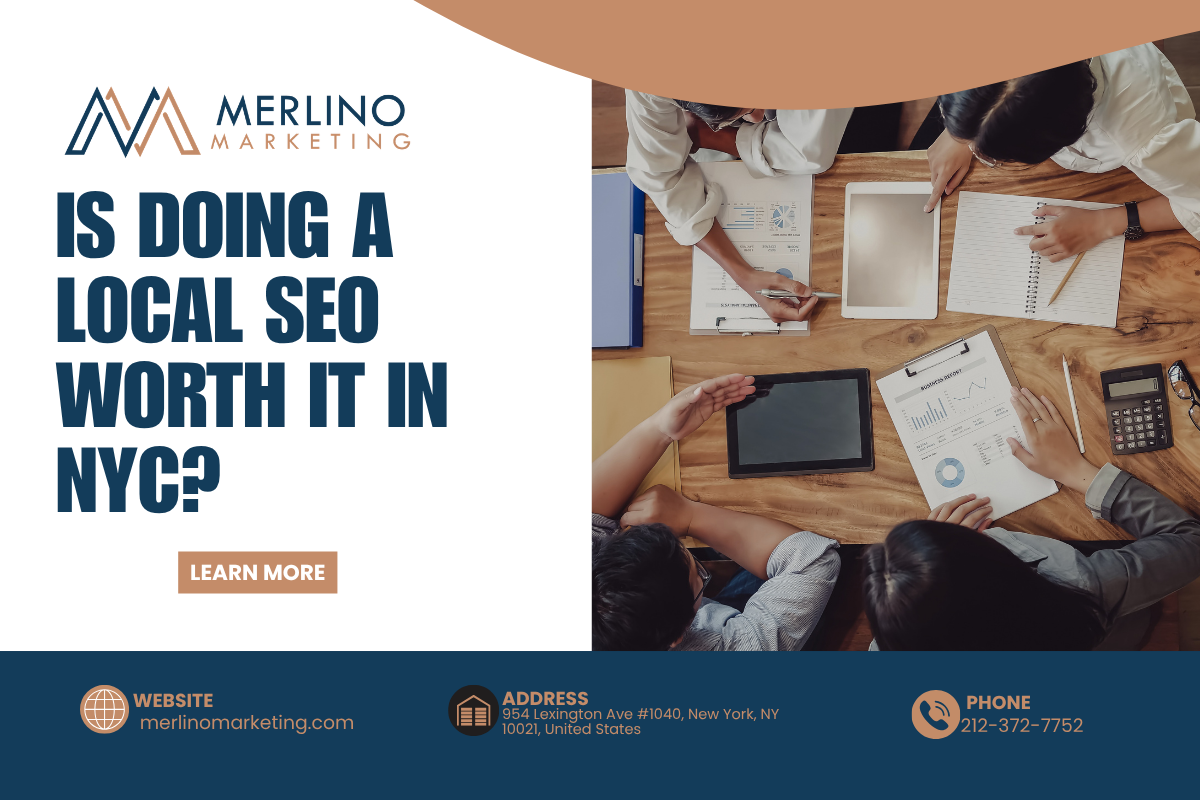
For a New York City business evaluating where to put its next marketing dollar, local SEO competes against paid search, social advertising, billboards, and word-of-mouth. The answer to whether local SEO is worth it depends on how you measure ROI, over what time horizon, and what type of business you run.
Direct Answer
For most New York City service businesses, local SEO is worth it. The Google Local Pack appears above paid ads for the majority of high-intent service queries, and a business that earns a top-three map position generates qualified leads at no per-click cost. Unlike paid search, where visibility ends the moment the budget runs out, a well-executed local SEO program builds a compounding ranking asset that continues to produce results month after month.
The investment requires patience. Most NYC businesses see meaningful movement in Local Pack rankings within 60 to 90 days of a complete optimization, but reaching a stable top-three position in a competitive category typically takes four to six months of consistent effort. For businesses with a minimum 12-month planning horizon and a service offering where the average transaction value justifies the investment, local SEO consistently delivers among the highest returns of any marketing channel available to NYC small and mid-size businesses.
Key Takeaways
- A top-three Local Pack position in NYC generates ongoing qualified leads with no per-click cost, unlike paid search which stops the moment the budget runs out.
- The average Google Ads cost per click in NYC reaches $30 to $60 for competitive service categories. Local SEO achieves equivalent visibility at a fraction of that cost over a 12-month horizon.
- Review velocity and Google Business Profile completeness are the two highest-leverage factors, both of which can be improved without large ongoing budgets.
- The FTC's guidelines on honest review solicitation mean that legitimate review-building strategies are both compliant and effective for NYC businesses.
- IAB research consistently shows organic search visitors from local queries convert at higher rates than paid visitors, making the cost-per-acquisition math even more favorable.
The short answer
- Local SEO is worth it for most NYC service businesses with average transactions above $200.
- The breakeven point is typically six to nine months, after which leads arrive at near-zero marginal cost.
- Google Business Profile optimization and review building deliver the fastest ROI per dollar invested.
- Organic search visitors from local queries convert at higher rates than paid visitors, per IAB research.
- The ranking asset compounds over time, unlike paid ads which generate no lasting value.
How do you calculate the ROI of local SEO for a New York City business?
The starting point is the cost-per-lead comparison across channels. In NYC, Google Ads for competitive service categories typically runs $30 to $60 per click. At a 3 to 5 percent landing page conversion rate, that translates to $600 to $2,000 per acquired lead. A local SEO retainer in NYC commonly ranges from $800 to $3,000 per month, depending on competitiveness and scope. In months one through four, the cost-per-lead from SEO is higher than from paid search because rankings have not yet been established. By months six through twelve, as top-three Local Pack positions are secured, the incremental cost per new lead drops sharply. By year two, a business with stable rankings is generating leads at a fraction of the paid search equivalent, with no ceiling on volume.
A second dimension of ROI that many businesses undercount is the conversion rate advantage of organic traffic. IAB research on local search behavior consistently shows that users who find a business through organic map results convert at higher rates than those who arrive via paid ads. This is partly because organic results carry a trust signal that paid placements do not, and partly because a user who has scrolled past ads to find an organic result is demonstrating stronger intent. For a NYC business tracking conversion data in Google Search Console and their CRM, this difference in conversion quality often makes the organic SEO case even stronger than a raw cost-per-click comparison suggests.
Which types of NYC businesses see the strongest return from local SEO investment?
Home services businesses see the clearest ROI because their queries are almost entirely transactional and trigger Local Pack results with no interference from AI Overviews. A licensed plumber, electrician, HVAC technician, or general contractor in any of the five boroughs deals in high-ticket transactions ($500 to $10,000 or more) where a single new client from an organic ranking can justify months of SEO investment. The same logic applies to professional services: a law firm that lands one new client from a Local Pack ranking for "immigration attorney Queens" has earned back its monthly SEO retainer many times over.
Medical and dental practices represent another strong-return category. NYC residents frequently search for specialists by neighborhood and insurance acceptance, creating a large volume of hyperlocal transactional queries. A dental practice in Forest Hills, Queens that ranks in the top three for "dentist accepting MetroPlus near me" captures high-intent patients at a cost that compares favorably to patient acquisition through insurance directories or paid search. Businesses with lower average transaction values, such as coffee shops or fast-casual restaurants, face a less compelling SEO ROI calculation because the lead value is lower, though Local Pack visibility still drives foot traffic and cannot be dismissed.
Is Google Business Profile optimization worth the effort for NYC businesses with limited time?
Yes, and it is the highest-leverage starting point for any NYC business because it requires no technical knowledge, no ongoing content production, and no significant budget. A fully built-out GBP profile, with the correct primary and secondary categories, a complete service menu, accurate hours, and at least 20 high-quality photos, consistently outperforms incomplete profiles in Local Pack rankings even when the underlying website is basic. For businesses operating on tight budgets, GBP optimization alone can produce meaningful ranking improvements within 30 to 60 days at near-zero cost.
Review building is the second piece, and the FTC's clear guidelines make it straightforward to execute legally: businesses can ask satisfied clients to leave honest reviews, provided they do not offer discounts or compensation in exchange. A system as simple as a follow-up text sent after service completion, containing a direct link to the Google review form, can generate a steady stream of new reviews without any external software. Google's published best practices explicitly encourage businesses to "remind customers to leave reviews," confirming that proactive, honest review solicitation is both compliant and rewarded. For a NYC business spending two hours per month on GBP updates and review follow-ups, the return on that time investment typically exceeds that of any other two-hour marketing activity.
How long does it actually take for local SEO to pay off for an NYC service business?
The realistic timeline for most NYC service businesses is divided into three phases. In months one through three, the focus is foundational: GBP optimization, citation cleanup, and initial content production. Ranking movement is often minimal during this phase, though impressions in Google Search Console typically increase as the profile builds credibility. Businesses sometimes want to abandon SEO during this phase because the early results do not match the investment, which is precisely when competitors who did abandon it create an opening.
Months four through six typically produce the first significant ranking movements. Top-ten map positions become visible. The Local Pack appears for specific neighborhood queries. In months seven through twelve, as review velocity compounds and content depth increases, businesses in most NYC categories reach stable top-three positions for their primary service queries. The total investment through month twelve is typically $8,000 to $30,000 depending on retainer level and competitive category. Beyond month twelve, the cost per new lead from SEO decreases as the ranking asset matures, while the paid search cost remains constant or increases with competition.
NYC Local SEO: Investment and Return Timeline
Should a NYC business do local SEO in-house or hire an agency?
The right answer depends on the business's competitive category and available internal resources. For businesses in lower-competition categories (a specialty retailer in a niche neighborhood, a solo practitioner in a specific professional subspecialty), a disciplined in-house approach to GBP management, review building, and basic content production can be sufficient. The foundational work is learnable, and Google's own GBP help documentation provides clear guidance on what signals matter most. A business owner willing to invest three to five hours per month on their Google presence can make meaningful progress without an agency.
In competitive NYC categories, including general law, home services, healthcare, and financial services, an agency with demonstrable NYC market experience typically outperforms an in-house effort because local competitive analysis, technical SEO auditing, and content gap identification require specialized knowledge and tools that are costly for a single business to maintain. When evaluating agencies, the IAB recommends looking for transparency around the specific tactics being used, access to your own Google Search Console and GBP data, and regular reporting tied to business outcomes (leads generated, calls tracked) rather than vanity metrics (keyword rankings alone). The FTC's guidelines on digital marketing endorsements are also relevant when an agency promises guaranteed rankings, which is not a promise any reputable SEO provider makes.
When is local SEO not worth it for a New York City business?
Local SEO delivers weak ROI when the business's clients do not find services through Google search. Purely referral-driven businesses, those serving a closed network of existing relationships (certain B2B professional services, insider-network financial advisors), or businesses whose clients discover them through industry events rather than search have limited need for local map visibility. Similarly, businesses with very low average transaction values, where even a 10x increase in search traffic would not generate meaningful revenue, may find their marketing budget better spent on channels with faster feedback loops.
Local SEO is also not the right short-term fix for businesses that need leads in the next 30 days. The foundational work takes time to register with Google, and no ethical SEO provider can guarantee map rankings by a specific date. For immediate lead generation, paid search or targeted social advertising delivers faster results, and many NYC businesses run both simultaneously: paid ads for immediate leads while local SEO builds the long-term organic asset. The decision is not either-or, but the planning horizon must be honest. Businesses that invest in local SEO expecting paid-search-speed results consistently exit before the compounding returns begin.
How does local SEO ROI differ across New York City's boroughs?
What do NYC business owners ask most often about whether local SEO is worth it?
What should a New York City business do in the next 30 days to start building local SEO ROI?
For most New York City service businesses, local SEO is worth it. The math favors it, the behavioral data supports it, and the competitive landscape rewards those who invest early and sustain the effort. The businesses that see the clearest returns are those that go in with realistic timelines, track the right metrics, and treat their Google presence as an ongoing business asset rather than a one-time project. If the decision still feels uncertain, the lowest-risk starting point is optimizing a Google Business Profile and launching a review system. Both are nearly free, both deliver measurable results within weeks, and both provide a concrete basis for evaluating whether the full investment makes sense for your specific category and market.