Merlino Marketing · April 2026
Does local SEO still work in NYC?
With AI Overviews, zero-click results, and Google's relentless algorithm updates, NYC business owners are asking whether local SEO is still worth pursuing. The answer is yes - but the tactics that worked three years ago often fall flat today.
Direct Answer
Local SEO still works in New York City. Businesses that maintain an accurate Google Business Profile, earn consistent five-star reviews, and publish content matching real search queries routinely appear in the Local Pack above paid ads - at no per-click cost. Google's own published guidance confirms that relevance, distance, and prominence determine map rankings, and all three remain influenceable through deliberate optimization.
What has changed is the competitive floor. NYC has more businesses per square mile than almost any U.S. market, so a bare-minimum listing that would rank in a suburban town rarely cracks the top three here. Businesses that invest in structured citations, review velocity, and landing pages tied to specific neighborhoods consistently outperform those relying on a set-it-and-forget-it profile. Local SEO works - for those willing to work it.
Key Takeaways
- Google's Local Pack still displays above paid results for most 'near me' and service queries - organic placement delivers ongoing traffic with no cost per click.
- Review velocity matters as much as star rating. A 4.6-star profile with 12 new reviews this month outranks a 4.8 profile with no recent activity.
- Neighborhood-specific landing pages outperform generic city pages in hyper-local NYC searches - Google rewards topical relevance to sub-geos.
- AI Overviews and zero-click answers affect informational queries far more than transactional ('plumber near me') queries where local map results dominate.
- The IAB's research on local digital advertising confirms that organic local visibility drives higher purchase intent than display or social ads for service businesses.
The short answer
- Local Pack still shows above ads for most NYC service queries - visibility is free once earned.
- Reviews with recent dates carry more ranking weight than a high average score alone.
- Neighborhood-level content wins in NYC's hyper-local search environment.
- Zero-click impacts informational content far more than transactional local queries.
- Businesses that updated their strategy in 2025 report stronger local rankings than those that did not change anything.
Is the Google Local Pack still showing up for NYC service searches in 2026?
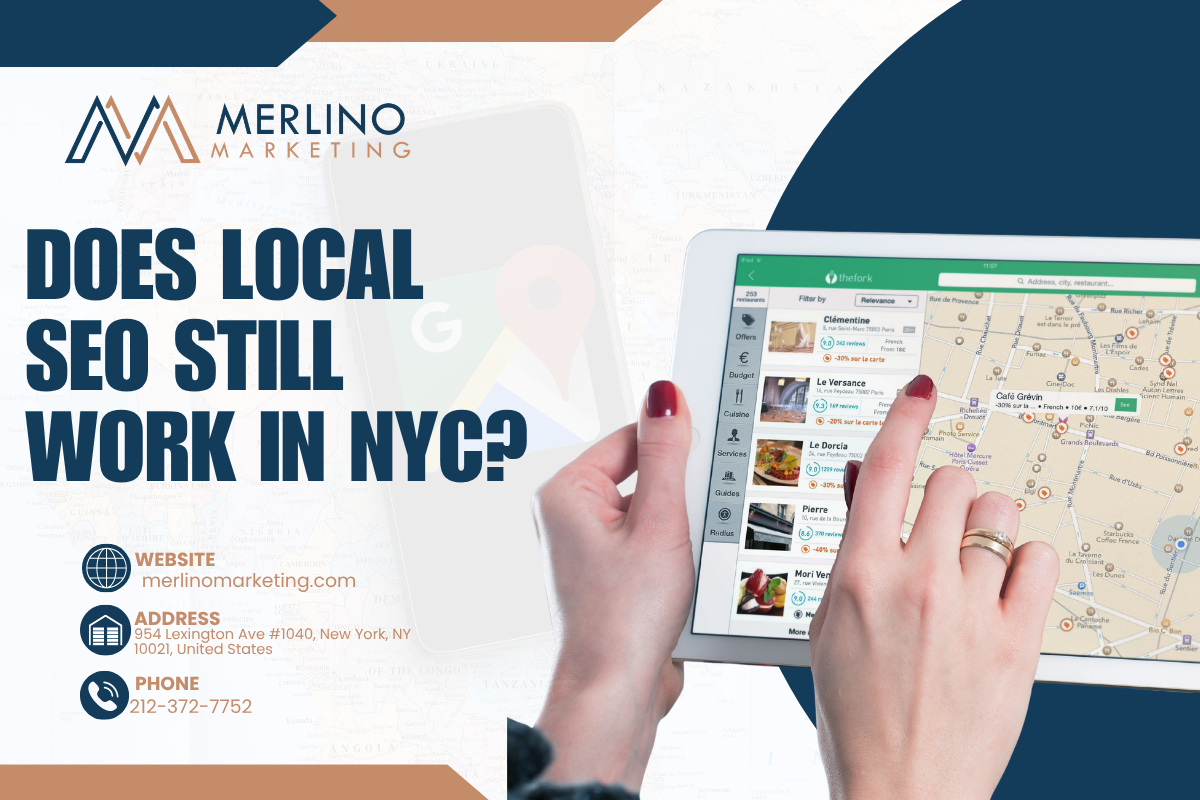
Search for "electrician Lower East Side" or "accountant Midtown Manhattan" and the three-pack map block still dominates the top of the page, sitting above every paid ad. Google's own published documentation - updated continuously through the Search Liaison's public communications - confirms that the Local Pack remains the primary interface for connecting users with nearby service providers. For high-intent transactional queries, the local map block consistently receives a larger share of clicks than either paid search or organic blue links.
The concern about AI Overviews erasing local visibility is understandable but largely misplaced for service businesses. AI-generated summaries cluster around informational queries - "how does plumbing work" or "what is an SEO audit" - not around queries with commercial intent. When someone types "emergency plumber near me" in Brooklyn at 11 p.m., they get a map with phone numbers, not an AI paragraph. Google has a financial and user-experience incentive to keep local commerce results prominent, and the data supports that this is exactly what happens.
How much do Google reviews affect local rankings in New York City?
Reviews are one of the three Google-acknowledged ranking signals for local results, alongside relevance and distance. In NYC, where proximity is often identical across competitors sharing the same block, reviews frequently serve as the tiebreaker. What practitioners observe consistently is that velocity matters as much as volume. A 4.5-star profile that has received 20 reviews in the past 60 days routinely outranks a 4.9-star profile with 200 older reviews and no recent activity. Google interprets recent review activity as a signal of an active, trustworthy business - essentially a freshness modifier applied on top of raw star rating.
NYC businesses face a specific review challenge: the city's transient population and high foot traffic produce a large share of one-time visitors who rarely leave reviews unless prompted. Systematic follow-up - a post-service email, a printed card, or a brief text with a direct review link - can dramatically accelerate velocity. The FTC requires that any review solicitation be honest and not incentivized with discounts or gifts, so the simplest approach is simply asking satisfied clients to share their experience. Google's own help documentation echoes this, encouraging business owners to "remind customers to leave reviews" as a legitimate profile optimization strategy.
Do neighborhood-specific pages help NYC businesses rank higher in local search?
Yes - and the effect is more pronounced in NYC than in most other markets. The city's neighborhoods function as distinct search markets. A residential cleaning company in Park Slope competes in a separate Local Pack from the same company serving Williamsburg, even though those neighborhoods are under two miles apart. Google's relevance algorithm processes the searcher's precise location and the geographic specificity of the landing page when deciding which businesses to surface. A page titled "House Cleaning Services in Park Slope, Brooklyn" with content referencing local landmarks and building types outperforms a generic "Brooklyn cleaning" page for Park Slope searches.
Effective neighborhood pages do more than swap a location name into a template. They address genuine differences in the local context - building stock (brownstones vs. high-rises vs. co-ops), common client concerns (narrow access, doorman buildings, HOA rules), and hyper-local references (proximity to a park, a business district, a transit hub). This specificity signals to both Google and the reader that the business actually serves that neighborhood rather than merely claiming coverage. IAB research on local content consumption confirms that geographically specific content consistently generates higher engagement and lower bounce rates than city-level generic pages.
Are AI Overviews hurting local NYC businesses in Google search results?
AI Overviews have meaningfully changed click behavior for informational content - blog posts explaining concepts, how-to guides, and definition articles now capture fewer clicks than they did in 2023. For local service businesses, however, the impact is considerably narrower. When a potential client types "HVAC repair Upper West Side" or "personal injury lawyer Flushing Queens," Google does not generate an AI paragraph summarizing HVAC repair - it shows a map and three businesses with phone numbers. The transactional structure of service queries insulates them from the zero-click shift.
The businesses most affected by AI Overviews are those that built organic traffic primarily through informational content - guides, FAQs, explainer articles. If a local marketing agency published a "what is local SEO" article and ranked on page one, that traffic has likely declined. But the underlying service page - "Local SEO for NYC businesses" - faces no such pressure, because service queries still resolve to direct contact options. Smart businesses are responding by making sure their Google Business Profile is fully built out and their service pages are clearly optimized, so that when a query does trigger map results, they are the ones showing up.
Where Clicks Go for NYC Service Queries
What changed in local SEO in 2025 that NYC businesses need to know about?
Google made several changes in 2025 that altered the competitive landscape for NYC businesses. The most significant was a refinement to how it weights behavioral signals - specifically, how often people click on a listing, request directions, or call from the search results page. Businesses that consistently earn these micro-conversions in their GBP listing see a compounding ranking advantage. This means that even a well-optimized profile with strong reviews can slip if the listing's photos, service descriptions, and response quality are not compelling enough to generate clicks.
A second shift was the expansion of GBP product and service menus. Google now extracts structured data from these sections and uses it to match service-specific queries. An NYC flooring company that lists "herringbone hardwood installation" as a distinct service in its profile can now appear for that specific query, where before it would have needed a dedicated website page. The IAB's 2025 state of local advertising report noted this as one of the most underutilized optimization opportunities for small and mid-size businesses, particularly in dense urban markets like New York where query specificity is higher than in suburban or rural markets.
What steps should a New York City business take today to improve local SEO?
The starting point is a thorough audit of the Google Business Profile. Ensure every service category is selected (GBP allows a primary category plus up to nine secondary categories), service descriptions use the specific language clients actually search for, and photos are recent - meaning within the past six months. Then verify that the name, address, and phone number on the profile match exactly what appears on the business website and on every directory listing. Even small inconsistencies - "St." vs. "Street," a suite number that appears in some listings and not others - dilute citation strength and can suppress rankings.
After the profile is solid, the next lever is the website's local landing pages. Each major service needs its own page with content that addresses how that service is delivered specifically in New York City - the licensing requirements, the typical client scenarios, the neighborhoods served. Google's published quality guidelines describe this kind of specificity as a signal of "expertise, authoritativeness, and trustworthiness." A page written by someone with genuine experience serving NYC clients reads differently from a keyword-stuffed template, and Google's quality raters are trained to distinguish between them. Businesses that prioritize genuine depth over thin geographic coverage tend to hold rankings through algorithm updates, while those relying on outdated tactics routinely find themselves cycling in and out of the pack.
How does local SEO effectiveness vary by NYC borough?
What do NYC business owners ask most often about local SEO in 2026?
What can you do in the next 30 minutes to improve your NYC local SEO?
Local SEO in New York City is competitive - but it is not a closed game. The businesses that show up consistently in 2026 are not necessarily the largest or the oldest. They are the ones that treat their Google Business Profile as a living asset, respond to every review, build content around the specific neighborhoods they serve, and stay current with the signals Google has explicitly said it uses. For NYC businesses willing to take that approach, local search remains one of the highest-return marketing channels available.